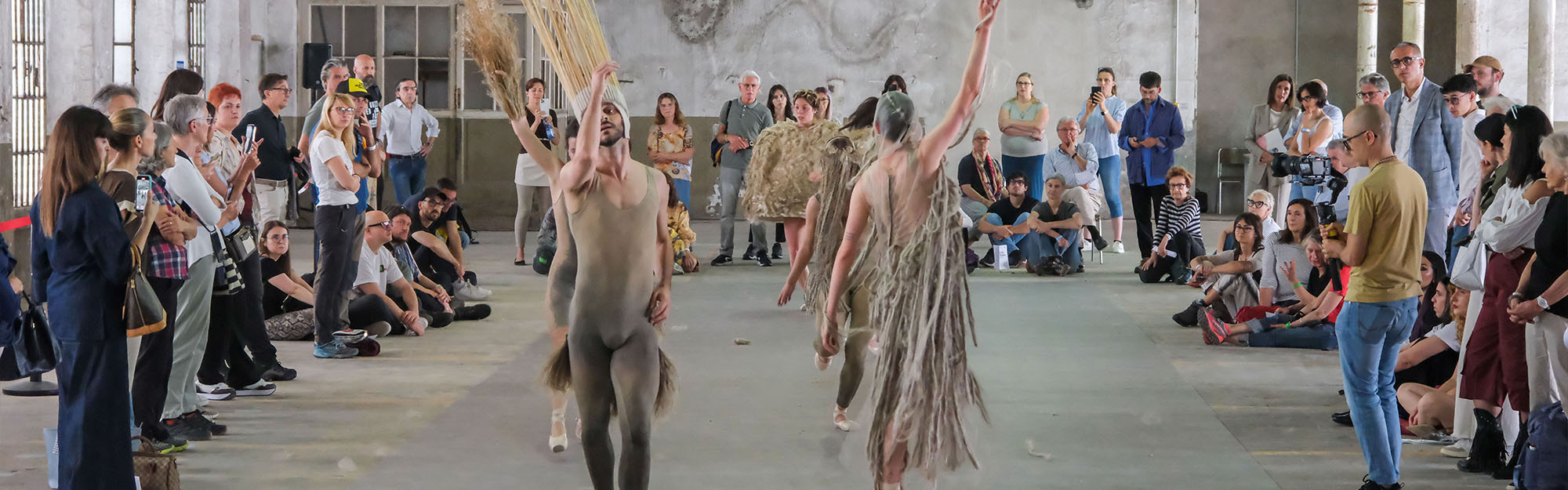
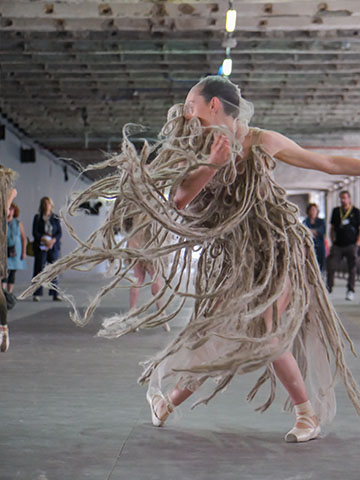
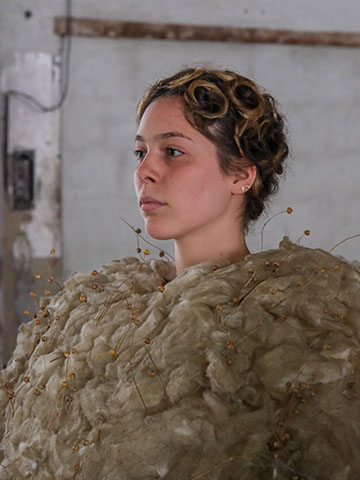
Cecilia Bengolea Spin and Break Free, 2025 Performance Linificio e Canapificio Nazionale, Villa d’Almè GAMeC / Il Biennale delle Orobie – Pensare come una montagna Courtesy l’artista Foto: Paolo Biava
Spin and Break Free
The project by Cecilia Bengolea at the Linificio e Canapificio Nazionale, Villa d’Almè
Saturday, June 7 In the industrial spaces of the former winding department of the Linificio e Canapificio Nazionale in Villa d’Almè, over 220 people gathered to welcome Cecilia Bengolea, an artist, choreographer, and dancer whose practice spans video, sculpture, and performance. Cecilia Bengolea (Buenos Aires, 1979) often uses dance as a medium to stimulate empathy and encourage emotional exchange.
On June 7, she introduced Spin and Break Free, a site-specific performance developed as part of “Pensare come una montagna – Biennale delle Orobie” by GAMeC, Galleria d’Arte Moderna e Contemporanea di Bergamo. Pensare come una montagna is a contemporary art program promoted by GAMeC – Galleria d’Arte Moderna e Contemporanea di Bergamo, which crosses Alpine and Prealpine territories, inviting artists, audiences, and the public to slow down, immerse themselves, listen to the land, and try to think like a mountain.
A deep, ecological, and shared reflection.
A project that also involves Linificio e Canapificio Nazionale SB®. Just as mountains suspend history between past and future, the program is rooted in the memory of places, transforming them into spaces for relationships and imagination. Both intertwine stories and knowledge, bodies and landscapes, creating patterns in which time and perception are suspended.
The workSpin and Break Freeis inspired by the rotary and mechanical movements of the historical machinery used for winding linen and hemp yarns, intertwining the memory of textile work with the Free Dances of the 1930s. The choreography, performed by six dancers from the Centro Studi Danzareadi Mozzo, reflects on the dynamics between mechanical gesture, repetition, alienation, and the possibility of individual liberation.
The costumes, created in collaboration with Alberto Allegretti, are made from linen and hemp fibers in various stages of processing, recalling the rituals of Theyyam from Kerala, India, where dance becomes a tool for connecting with the earth and one’s deepest roots. The sculptural and material silhouettes of the costumes highlight transformation and the dialogue between nature and industry.
In the dialogue between art, nature, and industry, Linificio becomes a crossroads of sensitive practices and poetic visions, welcoming Bengolea’s research as a contemporary echo of ancient ritual gestures.
In this context, the mountain was not just a backdrop, but a teacher of slowness and depth: a model of thinking that digs, sows, and regenerates.
Creative team:
Choreography: Cecilia Bengolea
Costumes: Alberto Allegretti & Cecilia Bengolea
Sound design: Theo Carrere, Dub High Elements, Jideh
Dancers: Francesca Carobbio, Martina Galluzzi, Alessia Morgandi, Francesca Oprandi, Umberto Rota, Virginia Gotti (Centro Studi Danzarea)
Spin and Break Free. I 600 Fili is the film by Cecilia Bengolea, shot in Super8 format within the production areas of Linificio e Canapificio Nazionale SB | B Corp® and during a performance hosted at Villa d’Almè.
Bengolea drew inspiration from the rotary and mechanical movements of the machinery used for spinning linen and hemp, weaving together the repetitive motions of textile work with the spontaneity of 1930s Free Dances. Pairs of opposites such as mechanicity and liberation, constraint and improvisation, alienation and rebellion run through every visual and sound element in the work.
The linen and hemp costumes, designed by Alberto Allegretti and inspired by the Indian Theyyam ritual, transformed the dancers of Danzareainto living sculptures—symbols of an energy that is progressively released, culminating in the final round-dance that evokes the joy of childhood. As the performance evolves, the dancers shed their constraints and gain greater freedom, turning the choreography into a celebration of life—an invitation to rediscover the naturalness and wonder of childhood.
The alternating voices in the soundtrack come from spinners and former spinners of the Linificio: Nicoletta Fagiani, Carla Gelmini, Wanda Gelmini, Claudia Cortinovis, and Manola Carminati, who are guardians of a memory and know-how that still lives on in the threads, gestures, and people. A deep dialogue between art, industry, and memory, celebrating the beauty of craftsmanship, the poetry of movement, and the power of natural materials to tell ever new stories of enterprise.